ACCESS NETWORK STORIES
Mandy at the Mission
Mandy is a young woman who has been staying at the Hope Mission since before the Network was first introduced to her in June 2020. Her name was brought forward by the Hope Mission nursing staff; they were very concerned about how vulnerable Mandy was.
Although Mandy was connected to Hope Mission and the 24/7 Crisis Diversion Program, no one really knew much about Mandy as she kept to herself and was almost completely non-verbal. Rather surprisingly in June, she warmed up to the Hope Mission nursing staff. It appeared to the staff that Mandy was being repeatedly sexually exploited by the same individual(s) and, due to her lack of verbal skills and/or capacity, was unable to take any kind of action herself. When the 24/7 Connector accompanied her to the hospital in June for an assault, for example, Mandy was unable to confirm that anything had happened, and unable to consent to a rape kit, so the hospital staff was unable to proceed. Further, although they acknowledged the need, police could not proceed with an investigation without expressed consent, which Mandy was not able to give.
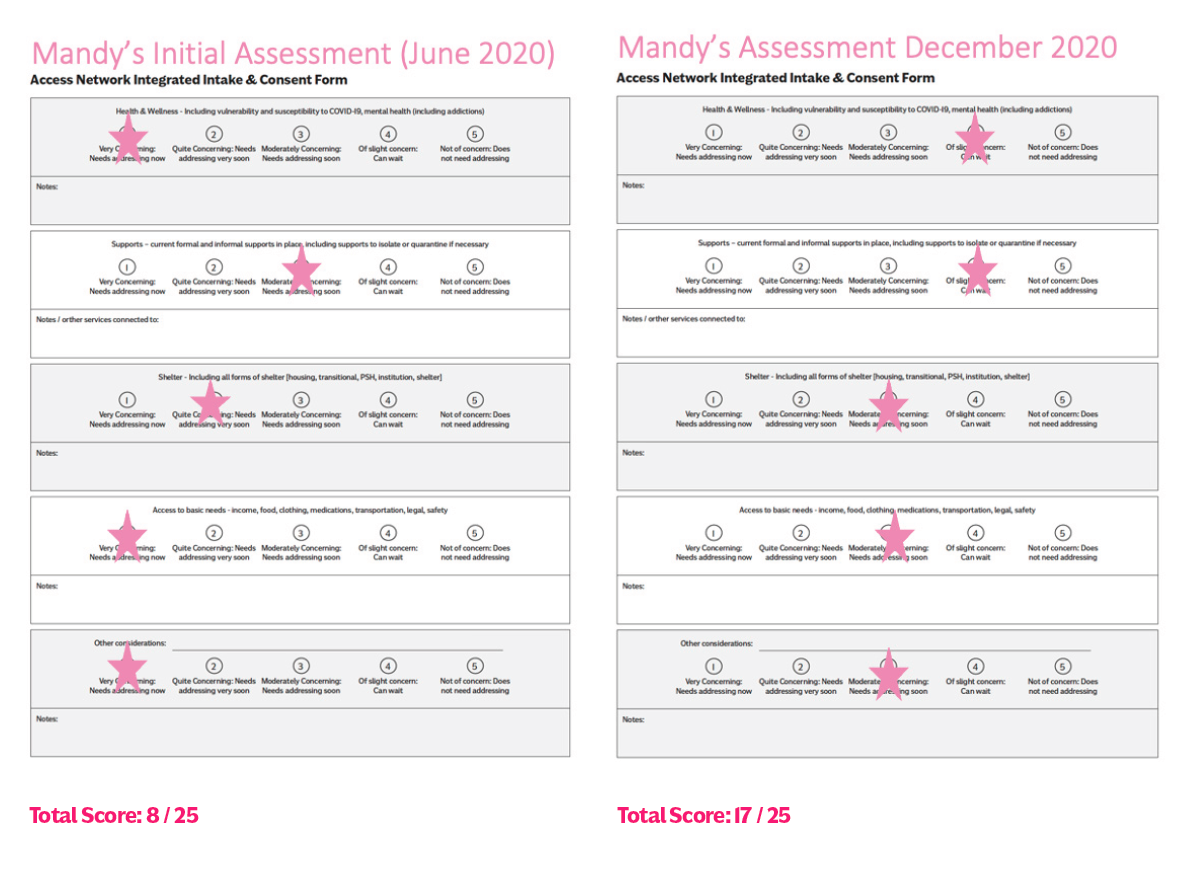
When we first started working on Mandy’s case, she had no income, no housing, no identification, no connection to family, no medical attention, no mental health support, and no legal support to pursue charges for the sexual assaults.
Members of the Network rallied together to provide support to Mandy. She was connected to the Intensive Community Transitions Team (ICTT). Between the Hope Mission, the 24/7 Connector, the ICTT and the Boyle McCauley Health Centre (BMHC), Mandy was assisted to see a doctor. Gradually she began to open up to people, she shared where she was from, talked about her upbringing and some details about her family.
Since June, Mandy has had continued to receive medical care from BMHC. She has seen a psychiatrist and been assessed for capacity. Her family has been found and they have been reconnected; her family has indicated they would like to help support her. Applications for AISH and for a public guardian have been started. Once the guardianship is in place, the police will be able to start an investigation into Mandy’s case and hopefully arrest her assailants. Mandy has become a lot more interactive with staff and has been going out into the community more. Although she is currently still staying at the Hope Mission, she is on the wait list for housing (which is taking longer due to a COVID outbreak). Recently, Mandy went to visit family for the holidays.
As the work with Mandy is still ongoing, it is likely that subsequent assessments will reflect further improvements; however, you can see that significant shifts have been made in Mandy’s case. Due to the complexity of the case, it is unlikely that such significant changes could have been made without the involvement of multiple members of the Network working together in a coordinated way.