ACCESS NETWORK STORIES
Numbers can only tell us so much: Jonas' story
Numbers can tell us only so much. Here is a story about Jonas. Jonas is a young man who came onto the Access Network radar in late April 2020. He was brought forward because of his extreme vulnerability. Jonas had no income, doesn’t stay in shelters and doesn’t camp; instead, he wanders all night, through all areas of the city. It is not uncommon to find him wandering without shoes. Because of his extremely poor mental health and resulting unpredictable behaviour, Jonas is routinely banned from drop-in centres where he could normally access support. Since he is not using drop-ins, and doesn’t stay in one part of the city, he is very difficult to locate; providing him any kind of support is very tricky.
AHS’s Intensive Community Transitions Team (ICTT) at the time had limited dealings with Jonas. On those occasions, he has appeared to understand his own vulnerable situation and expressed wanting support.
It should be noted that Jonas is an exceptionally likeable and friendly young man; those who come into contact with him generally make a connection with him quite quickly and feel compelled to ensure he receives the support he requires. The challenge has been finding Jonas and then coordinating this support for him.
Near the end of April, Jonas was arrested and was incarcerated for a few weeks. The ICTT capitalized on the fact that Jonas would be in one place for a while and used this opportunity to connect with him. Jonas had not been taking his medication, although was open to doing so. When Jonas was released, he was released with a Community Treatment Order and started his medication again. Further, his income had been reinstated.
The City of Edmonton Peace Officers had ICTT flagged on their system as a contact for Jonas and would alert them if they had any issues with Jonas’s behaviour. Jonas was still hard to locate although it was believed that he was spending more time in the river valley at this time. ICTT discussed coordinating with Street Outreach to see if they could help with finding him when needed.
During the May 26 Access Network meeting, we were discussing some of the updates with Jonas’s case. It came to light that Jonas suffers from debilitating back pain and had been presenting to emergency rooms over and over for this back pain but always left against doctor’s orders. Boyle McCauley Health Centre (BMHC) offered to help connect him with one of their doctors. Before the meeting was over, BMHC had a doctor offering to go and see Jonas in the river valley and an appointment time. BMHC and ICTT planned to work together to ensure that this appointment would happen.
In the days that followed, Jonas experienced an overdose and was taken to the UofA hospital. The Peace Officers involved contacted ICTT right away and ICTT was able to go and pick Jonas up upon his release. Jonas was able to meet with the BMHC doctor – in the park! It was determined that Jonas has serious issues with his spine, which explained the debilitating pain he was experiencing. Jonas will require surgery for his back issues. The doctor provided Jonas with a prescription for pain medication and began the process for him to have his back issues properly addressed. The doctor also advocated for Jonas to have a hotel room for the night, as wandering around the city was not helping the issue. The Peace Officers followed up with ICTT to make sure Jonas was doing okay.
Jonas received his medications and did a housing intake the very next day and is now in transitional housing waiting for a more permanent housing placement. He has already chosen where he would like to live. Six weeks later, no-longer-shoeless Jonas has multiple people around him who know him, care about him, treat him with respect and dignity, and give him the care and treatment he deserves. A social safety net has begun to develop.
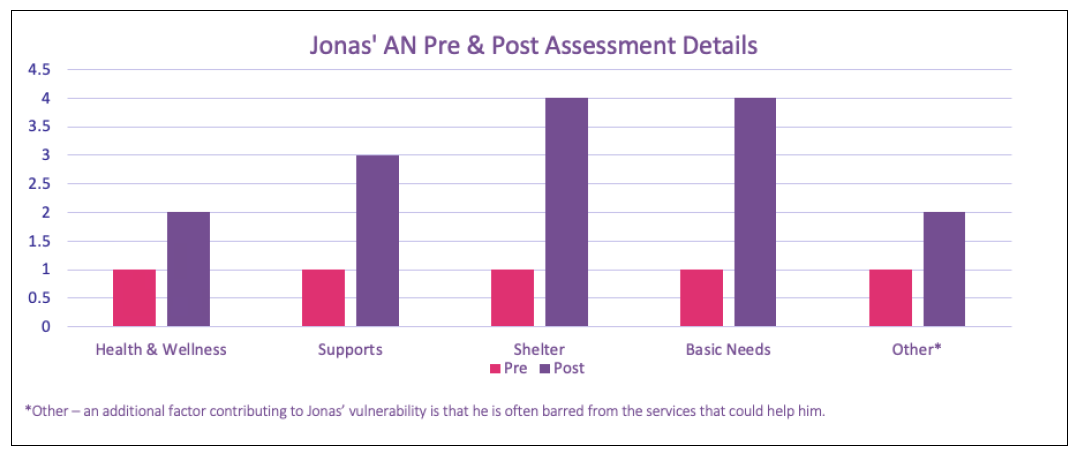
We did a brief assessment with Jonas when we first met him and then did another one a few months later, which you can see below.
Jonas’ assessment scores have improved in all categories. Overall, his score went from 5/25 (20%) to 15/25 (60%), which is impressive in such a short amount of time. The ability to have such significant impacts is largely in part to the amazing workers who work tirelessly to support vulnerable Edmontonians; however, we can also attribute this success to the networked, coordinated approach that partners took to supporting Jonas.